Postagens

Mostrando postagens com o rótulo architecture

The Culmination of Brazilian Modernity
Imagem
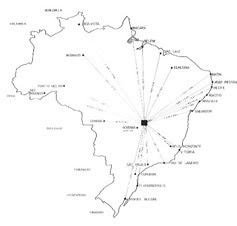
My little tribute to Brasilia's 50 Birthday... Planted deep in the heart of the central plateau, Brasília has its origins in the early years of the colonial period, when the idea of building a new capital was first suggested: “The first recorded advocacy of a new capital appeared in 1789 in a statement by a group of political revolutionaries in the state of Minas Gerais, who called themselves ‘inconfidentes mineiros.’ Pioneers in the movement for independence from Portugal, they incorporated in their program the concept of a new governing center, free of the symbolic associations with the colonial regime.” (Evenson, 1973).  In 1821, Bonifácio de Andrada, the patriarch of Brazil’s independence, recommended to the deputies at the Court of Lisbon: “there shall be erected a central town, in the interior of Brazil, as the seat of the court or regency…”. In 1883 an Italian priest known as Dom Bosco had a ‘dream-vision’, in which he saw the ‘promised land’ between the 15th and 20th d...

Upgrading La Esperanza - Part 4 of 4

Imagem
Note: The following is a shortened version of the graduate report prepared for the Minimum Cost Housing Group (MCHG) of McGill University, Montreal. This report was written by myself, along with Cesar Gonzales, Tong Gan, Yue Li, Annalyn Maribbay and Alejandro Lopez.   Proposals for Physical Aspects Community Level Community Self-Help Centre:  The proposed Community Centre would be located on the current plot along street 21 and street 7. This vacant plot has large trees, which shall remain, and also an existing open shed. This is where the school was formerly located.  The area being accessible from the main entrance to the community by primary streets makes it an ideal place for important social gatherings. Several community activities would be encouraged to be held there:  Education and Training:  A self-help centre was located within this area, catering for the residents' needs and helping define the upgrading process. This is where educatio...

Upgrading La Esperanza - PART 3 of 4

Note: The following is a shortened version of the graduate report prepared for the Minimum Cost Housing Group (MCHG) of McGill University, Montreal. This report was written by myself, along with Cesar Gonzales, Tong Gan, Yue Li, Annalyn Maribbay and Alejandro Lopez.   Second Layer: Design Proposals Objectives The main objective of these proposals is to provide the community of La Esperanza, as well as the local governmental agencies, with a sound base from which they can, in a progressive and self-sustainable manner, improve the living conditions of the settlement. The role of the upgrading process, though, should be defined not by itself, but by the end users, which must participate in all stages of its planning and development. The methodology for implementation assumes that people will be willing to take most of the action in their hands and invest part of their time, labor, and incomes in an effort that will eventually benefit all. Therefore, the main requirements for...

Upgrading La Esperanza - Mexico. PART 2 of 4

Imagem
Note: The following is a shortened version of the graduate report prepared for the Minimum Cost Housing Group (MCHG) of McGill University, Montreal. This report was written by myself, along with Cesar Gonzales, Tong Gan, Yue Li, Annalyn Maribbay and Alejandro Lopez. Community Development Since World War II when the term community development first came into use, its use has spread rapidly and been interpreted in different ways throughout the world. A United Nations report on community development in rural areas has emphasized two components: community Self-Help and technical assistance. The term 'community development' defines a process by which the efforts of the people are united with those of governmental authorities to improve the economic, social and cultural conditions of countries, to integrate these communities into the life of the nation, and to enable them to contribute fully to national progress. This process is made up of two essential elements: participatio...

Slum Upgrading - La Esperanza, Mexico.

Imagem
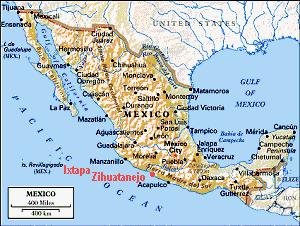
PART 1 of 4 Note: The following is a shortened version of the graduate report prepared for the Minimum Cost Housing Group (MCHG) of McGill University, Montreal. This report was written by myself, along with Cesar Gonzales, Tong Gan, Yue Li, Annalyn Maribbay and Alejandro Lopez. Introduction Usually one of the most frequently asked questions regarding the adoption of different approaches that deal with the issue of informal settlements is: relocate or consolidate? What are the advantages of upgrading and when should this approach be adopted? What are the lessons from the past that we should bring into consideration? It has been said that the relocation approach increases land use efficiency and improves the physical condition of houses by resettling the community in areas that are "more suitable" to urban living standards. Very often, governmental housing agencies rely on purely orthodox methodologies in order to identify the problems faced by poor communities and sele...

Brasilia: living within modernist standards

Imagem
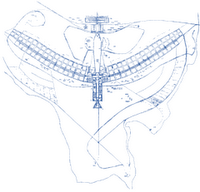
Brasilia: living within modernist standards by: Marcio N. de Oliveira (originally written in 98 for Maquis, my old Geocities homepage) Introduction: Latin American countries have always pursued a sense of urban utopia. Nowhere else have modernistic urban theories, above all Le Corbusier's, controlled the minds of practicing architects and urban designers as much as in Latin America and specially Brazil. Brasilia was designed according to them and quite clearly exemplifies the shortcoming of such urban theories. Erected in record setting time of three years (1957-60), the city was planned in relation to Brazil's need to conquer physically, culturally and economically its own continent sized countryside. With this short essay I intend to show one view, the one of a natural Brasiliense , born and raised in Brasilia, living the daily life within modernist standards. Superquadras and Apartment Blocks: In Brasilia's urban landscape the central city was made up of two dense res...

Eye hospital vid

Interessante, mas postei apenas p/ testar o "embed video"...:)